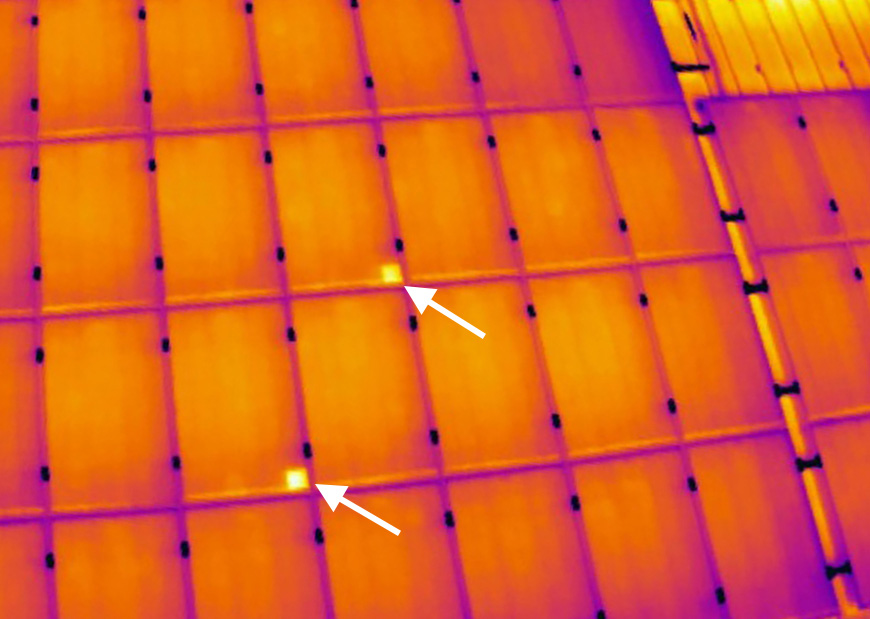
A hotspot doesn't announce itself. There's no alarm, no dashboard alert, no obvious dip that jumps out at your O&M team on a Tuesday morning. It just sits there — one cell running hotter than it should — quietly pulling down the output of an entire string, week after week, until someone finally goes looking for the reason a block is underperforming.
By the time that happens, the plant has usually already lost weeks or months of generation it will never get back.
What actually causes a hotspot
A hotspot forms when part of a module can't pass current the way the rest of the string can — a cracked cell, a bad solder joint, shading from bird droppings or debris, a delaminating laminate, or a failing bypass diode. Instead of contributing power, that cell starts absorbing it, and the energy has to go somewhere. It goes into heat.
Left alone, a hotspot doesn't stay a small problem:
Output loss — the affected string underperforms, often silently, since a single hot cell rarely trips a string-level fault
Accelerated degradation — sustained heat stresses the cell and surrounding material, so a small crack becomes a bigger one
Fire risk — in severe, prolonged cases, thermal runaway is a real safety hazard, not a theoretical one
The problem is scale. A 50 MW plant can have well over 100,000 modules. Walking that plant with a handheld thermal camera looking for a handful of hot cells isn't realistic on any kind of regular schedule.
Why drone thermography is the practical answer
This is exactly the gap aerial thermography was built to close. A drone equipped with a radiometric thermal sensor flies a pre-planned grid over the entire plant, capturing thermal and visual imagery of every module in a fraction of the time a ground walk would take.
What makes this useful — not just fast — comes down to three things:
1. Standards-compliant methodology. Thermal readings are only meaningful if they're captured under the right conditions: adequate irradiance, correct flight altitude and angle, calibrated sensors. IEC TS 62446-3 exists precisely to standardize this, so a hotspot flagged today is measured the same way a hotspot flagged next quarter is. Without that consistency, you can't trust the data enough to act on it.
2. Exact geo-tagging. A thermal anomaly is only actionable if your team can walk straight to it. Every finding needs to be tied to its precise block, inverter, string, and module — not "somewhere in Block C" — so a technician isn't searching a football-field-sized array for one warm rectangle.
3. Severity classification. Not every temperature difference is urgent. A well-run inspection separates a 2°C variance worth monitoring from a 20°C anomaly that needs a truck roll this week. That prioritization is what turns a stack of thermal images into a punch list your team can actually work through.
From detection to action
Finding the hotspot is only half the job. The other half is making sure the finding doesn't sit in a PDF report nobody opens. That's where a portal like SyloCloudAI matters — anomalies mapped against the plant layout, severity-ranked, with imagery attached, accessible to your team whenever they need it rather than locked in a one-time file.
A typical workflow looks like this:
Scheduled or on-demand drone flight covers the full plant footprint
Thermal and visual imagery is processed and cross-checked against IEC TS 62446-3 thresholds
Every anomaly is geo-tagged to its exact module and classified by severity
Findings land in a live portal — your O&M team gets a prioritized list, not a raw image dump
Repeat on a regular cadence so new hotspots don't sit undetected for another quarter
The bottom line
Hotspots are cheap to fix and expensive to ignore. A cracked cell caught early is a module swap. The same cell ignored for six months can mean a string derate, a safety incident, or a warranty dispute with no thermal history to back your claim.
Regular, standards-compliant thermal inspection is what turns "we think Block D is underperforming" into "Module B-14-07 has a confirmed hotspot, here's the severity, here's the location, fix it this week."
Want your plant's actual thermal condition mapped out? Book an inspection or reach out to our team — Arunima, Yash, or Neha are happy to walk you through how it works for a portfolio your size.