5 Trends Shaping Indian Solar O&M in 2026
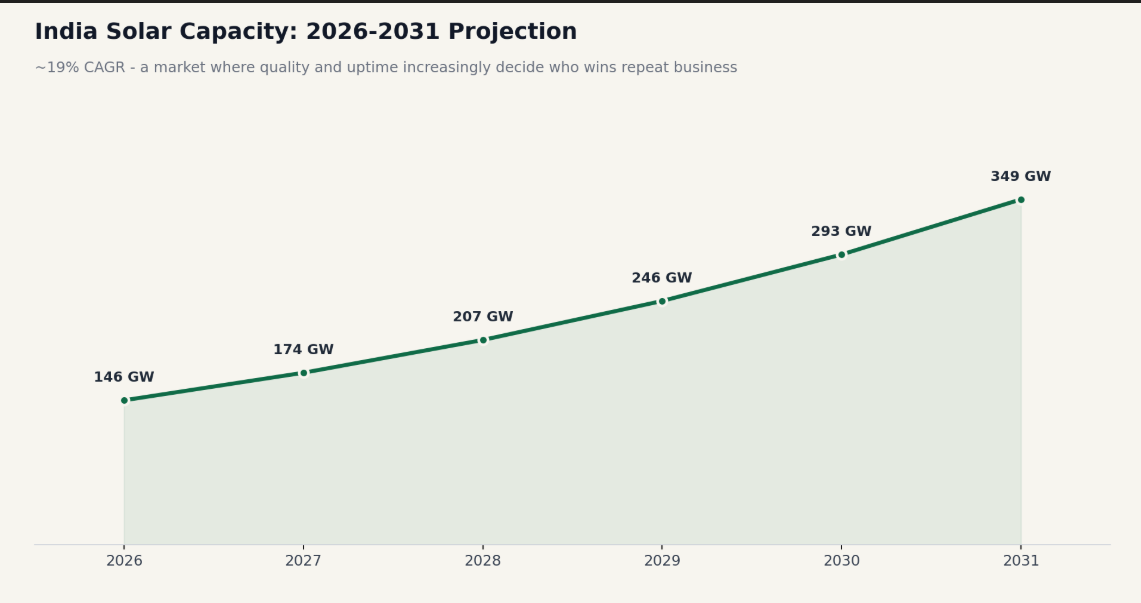
India's solar sector crossed into a new phase this year. The market stood at roughly 146 GW in 2026 and is on track to grow at close to 19% a year, putting it near 350 GW by 2031. That kind of growth used to be the whole story — capacity added, records broken. In 2026, the story has shifted. The question asset owners are asking isn't just how much capacity got built, but how well it keeps performing over its 25-year life.
Here are five shifts worth watching if you own, operate, or maintain solar assets in India right now.
1. O&M costs are falling, and margins are getting won on efficiency
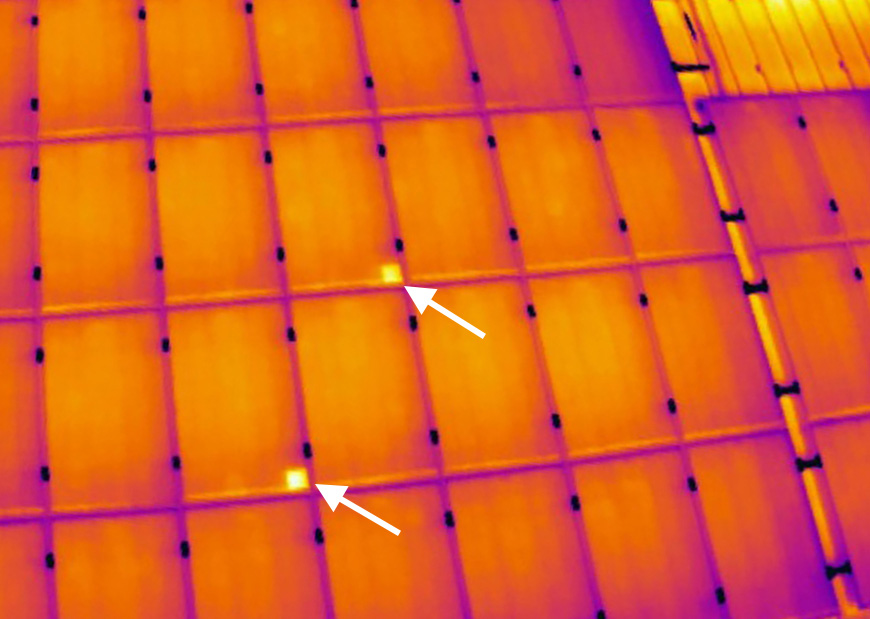
Utility-scale O&M costs have come down sharply — from the ₹8–12 lakh per MW per year range a decade ago to roughly ₹4–8 lakh per MW today, largely on the back of automation and scale. That's good news for asset owners, but it also raises the bar for O&M providers. When the baseline cost of keeping a plant running drops, competitive advantage stops being about doing O&M cheaply and starts being about doing it precisely — catching the hotspot, the micro-crack, or the degrading string before it becomes a bigger repair bill.
2. Grid curtailment is becoming a real constraint, not a footnote
For years, the Indian solar conversation was almost entirely about how fast capacity could be added. That conversation is changing. Generation is now outpacing the transmission infrastructure needed to carry it in several regions, and curtailment — where a plant is asked to generate less than it's capable of — is becoming a genuine planning concern for developers rather than an edge case.
For asset owners, this raises the value of squeezing maximum output from every MW that is dispatched. A plant losing 3–5% of output to undetected hotspots or degraded modules can't afford that loss quietly when curtailment is already capping how much it can sell.
3. BESS is moving from pilot projects to standard procurement
Battery storage paired with solar is shifting from experimental to mainstream, driven by falling battery costs and increasing SECI and state utility demand for round-the-clock and hybrid power. States with high renewable penetration are starting to treat storage as core grid infrastructure rather than an add-on.
This matters beyond the storage asset itself — it changes what "inspection" needs to cover. A hybrid solar-plus-storage site needs thermal monitoring that extends to the BESS enclosure and inverter room, not just the module field. Asset owners bringing storage online are having to build out this inspection scope essentially from scratch.
4. Domestic manufacturing is reshaping the supply chain — and the risk profile
Government policy continues to push domestic module and cell manufacturing, with ALMM (Approved List of Models and Manufacturers) requirements extending further into the supply chain through 2026. This is good for India's manufacturing base, but new manufacturing lines — however well-run — mean a larger share of modules entering the field are recent products without a long field-performance track record.
That's exactly the situation incoming quality control (EL testing before installation) exists for. Catching latent manufacturing defects before a module goes on a racking system is cheaper for everyone than discovering it two years into operation.
5. Portfolio consolidation is raising the bar for asset documentation
Large solar portfolios are increasingly changing hands, with global infrastructure investors and strategic players competing for assets once considered too fragmented to be attractive at scale. Every acquisition like this comes with technical due diligence, and due diligence is only as good as the inspection history behind it.
Plants with a consistent, standards-compliant record of thermal scans, EL reports, and module-level anomaly tracking go into that process with a clear story to tell. Plants without one go in as a question mark — and question marks get priced in as risk.
What this means in practice
None of these trends point toward less inspection. They point toward inspection that's more precise, more continuous, and more integrated into how a plant is actually managed — not a report generated once a year and filed away, but a live record that documentation, financing, and operations teams can all draw on.
That's the shift we've built Sylo around: standards-compliant thermography and EL testing that feeds directly into SyloCloudAI, so the data stays usable long after the drone lands.
Want to know how your portfolio's inspection program stacks up? Book an inspection or reach out to our team — Arunima, Yash, or Neha can talk through what a documentation-ready inspection program looks like for your scale.